

Is Evolution vs Creationism Really Science vs Religion?
Kia ora! Welcome back. I’m Hiro.
Last time, we kicked off the “Creationism: What They Don’t Teach You at School” series, where we explore the question of God’s existence through the lens of how the world came to be.
As I mentioned at the end of the previous post, starting from this second instalment, I’d like us to think together about the first sub-theme: “Is Evolution vs Creationism really Science vs Religion?” We’ll be exploring this over four parts.
It’s going to be a slightly longer series, so I hope you’ll stick with me to the end.
Thanks for being here.
Is the matter already settled? — Why I’d like you to think about this topic
“The fairy tale that some Creator made the world is nothing more than a superstition blindly believed in an era before science had developed. Evolution is a science built upon objective evidence gathered by scientists through experiments and observations, replacing the old, unsupported claims of creationism. Revisiting which one is correct would be like turning the clock back a hundred years. Evolution is science; creationism is religion. For us modern people living in the 21st century — an age of tremendous progress — debating this is a complete waste of time.”
This worldview has become common knowledge in our society today.
But is that really the case?
Thanks to the remarkable development of science and technology, human society has entered an age of material abundance and extraordinary convenience.
It’s easy to fall into the illusion that this material wealth represents great progress for society as a whole. But despite that feeling, the world is piled high with deeply serious problems, isn’t it?
It’s hard to believe that a bright future awaits us. Wouldn’t you agree that we live in such times?
Wars that never cease. Environmental destruction that only accelerates. Rising violent crime. The breakdown of family relationships. Increasing rates of suicide.
Take any one of these — the devastating reality that we can’t even find a thread of a solution clearly points to one thing: despite appearing to have made great progress, we human beings have, in fact, been making some serious mistakes along the way.
Imagine you’re walking towards a destination, but no matter how far you go, you just can’t seem to get there. Eventually, the moment comes when you realise, “I must have taken a wrong turn somewhere.” Perhaps now is precisely that moment for us — the time to recognise the mistakes we’ve been making.
If you keep pressing on down the wrong road, you won’t just fail to reach your destination — you’ll only drift further and further away from it.
When you’re lost, the smartest thing to do is go back the way you came. In the same way, I believe that tracing our steps back into the past to identify where things went wrong is a way to find a ray of hope amidst the heavy struggles of our present.
That’s why I’d like you to wind the clock back for a moment and take a careful, thorough look for yourself at the question: is evolution vs creationism really science vs religion?
That is the reason I want to encourage you to think about this topic.
So, in today’s Part 1 and next time’s Part 2, I’d like us to focus specifically on the question: “Is evolution really science?”
Is Evolution Really Science? (First Half)
When I say “science” here, I’m talking about “natural science” — that is, the study of the natural world. In school terms, think of it as your science classes.
To give you the conclusion up front: yes, evolution is science.
However, I think it’s extremely important to understand that it’s a very different kind of science from what most people typically picture when they hear the word.
To explain what I mean, I’d first like us to look together at what sorts of things are generally called “science”, and then see how evolution occupies a rather unusual position within that landscape.
Two kinds of science they don’t teach you at school — and the difference between them
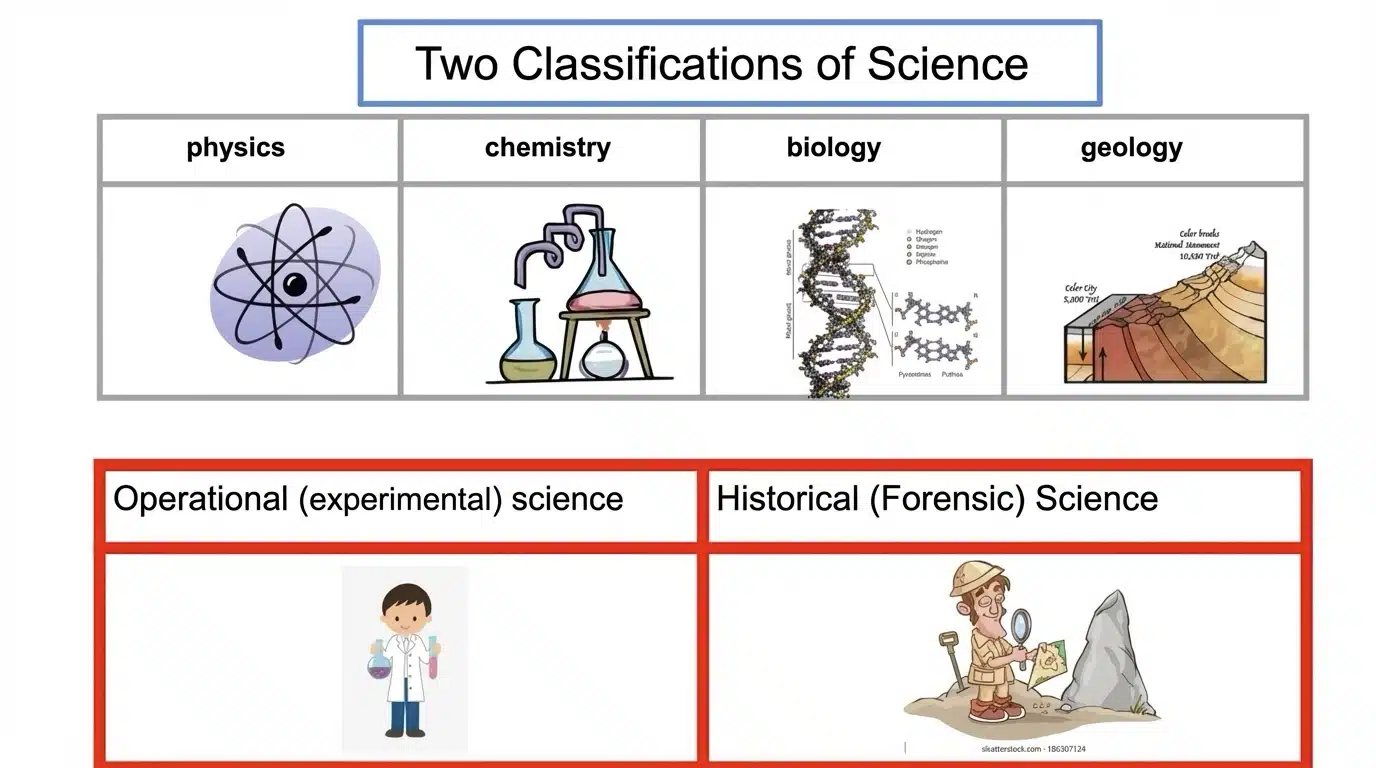
Science can be divided into four areas by subject matter.
Physics, chemistry, biology, and earth science.
That’s the division by content, shown in the top part of the diagram.
But if we look at it from a different angle, as shown in the bottom part of the diagram, science can also be divided into two categories.
That different angle is method — in other words, “How do you verify whether a hypothesis is actually true?” When we classify science by method, it splits into two types: “experimental science” and “historical science”.
Today, I want to talk about this second way of dividing science, because it holds the key to properly understanding evolution.
Let’s start by thinking together about what experimental science actually is.
What is experimental science?
Do you enjoy science?
When it comes to science class, it’s all about experiments and observations, isn’t it?
When I was a kid, we hardly ever got to do hands-on experiments, so I wasn’t that keen on science. But when I became a teacher and started running experiments myself, I thought, “Science is this much fun!” and fell completely in love with it.
I’m sure you’ve had experiences like mixing liquids together to cause a chemical reaction, changing how batteries are connected to measure current and voltage, or observing the surface of a leaf under a microscope.
Now, here’s a question for you.
Imagine you’re a school teacher.
During a science lesson, you’ve got the students doing an experiment. One group finishes in half the allotted time and comes up to you asking, “We’re done already — what should we do with the rest of the time?”
What instructions would you give them?
Would you say, “Start cleaning up your equipment”?
Or perhaps, “Read today’s section in the textbook”?
Or maybe, “Go and help the other groups”?
I’m sure you could come up with all sorts of instructions.
When I was working at a primary school in Japan, I once asked a teacher who was brilliant at teaching science what the best instruction would be in a situation like this. The answer I got was completely unexpected.
It was this: “Tell them to do the experiment again from the beginning.” That, this teacher said, is the important thing.
I remember thinking, “They’ve already got a result — why would you make them do the same experiment all over again? Isn’t that a waste of time?”
What do you think? What’s the point of repeating an experiment you’ve already done?
The purpose and importance of repeating experiments
As it turns out, repeating an experiment serves a very important purpose.
That purpose is to confirm with your own eyes that the result is genuinely, unmistakably factual.
No matter how convincing an experiment might seem, you can’t declare the result to be fact based on a single trial alone.
During the experiment, there may have been a misreading of a measurement, a slip-up in the procedure, or the equipment may have been used incorrectly. You can’t be absolutely sure that no mistakes were made, can you?
What’s more, when predicting the result beforehand, if a researcher has a strong expectation or preconception — “The result is definitely going to be this” — and then a different result comes out, it can be very hard to face the facts head-on. There are many cases where people unconsciously twist the data to fit what they were expecting.
To prevent human error and bias from creeping into experimental results, you have students repeat the experiment as many times as possible. That, this teacher told me, is what experimental science is all about.
In other words, in experimental science, the method involves repeating experiments and observations over and over, checking whether the same result comes out every time, everywhere, no matter who does it — and through this process, verifying whether something is really true.
When people say “science”, they mean experimental science
The reason “science” commands such enormous trust in our modern age is entirely thanks to the achievements of experimental science.
Through repeated experiments and observations, the results have been thoroughly confirmed to come out the same every time, everywhere, no matter who conducts them. They are undeniable facts — so of course they can be trusted.
And it’s the development of experimental science that has given us all the technologies we rely on every day — smartphones, computers, all kinds of vehicles, and the internet.
These inventions have made people’s lives dramatically more convenient and richer, and we now live in an age where science is regarded as all-powerful.
In other words, what people generally call “science” is, strictly speaking, experimental science.
Today’s Summary
1. Natural science can be classified by method into two types: experimental science and historical science.
2. The method of repeated experiments and observations is what gives experimental science its high reliability — and it’s what has made our lives so much more convenient.
3. When we simply say “science”, we’re really talking about experimental science.
Coming Up Next: Is Evolution Experimental Science?
So then — is evolution experimental science?
If evolution has already been proven using the methods of experimental science that we’ve been discussing, then the claims that the Earth is 4.6 billion years old or that humans evolved from bacteria by chance would be beyond any shadow of a doubt.
Well then — is that actually the case?
Next time, let’s think about this together.
Thank you so much for reading to the end.

